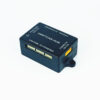
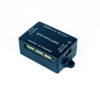
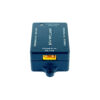
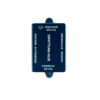
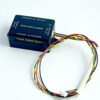
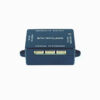
SwiftCAN-HUB – 6 Port Powered CAN Expansion Hub
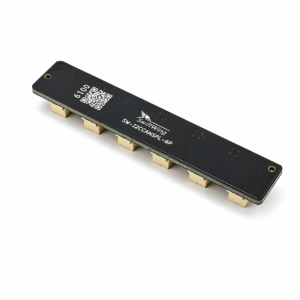
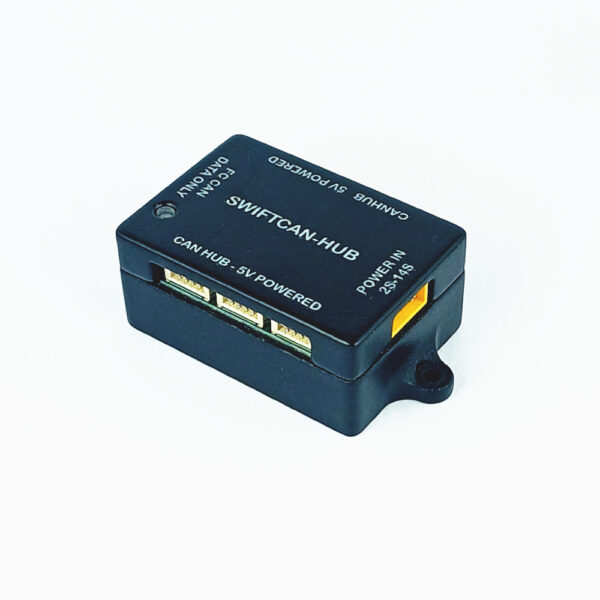
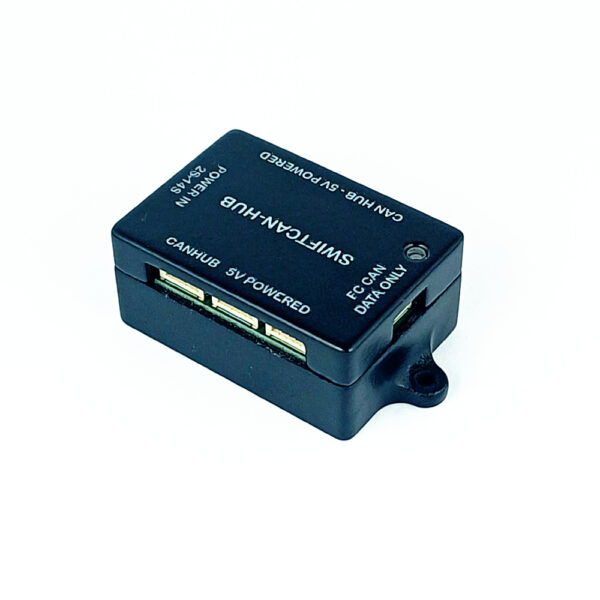
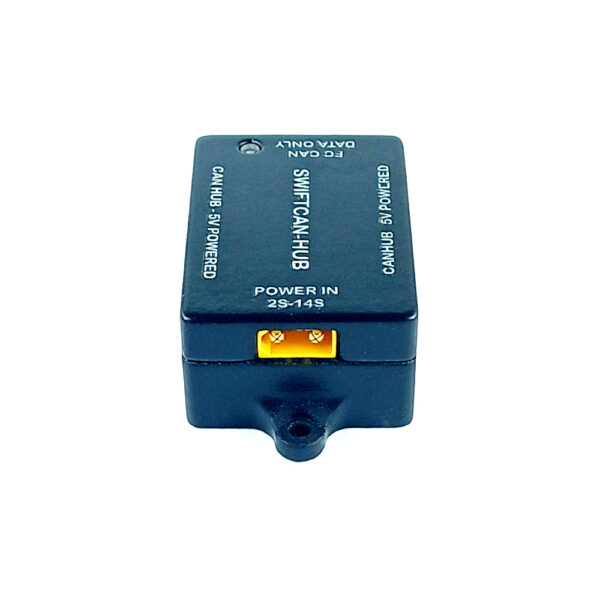
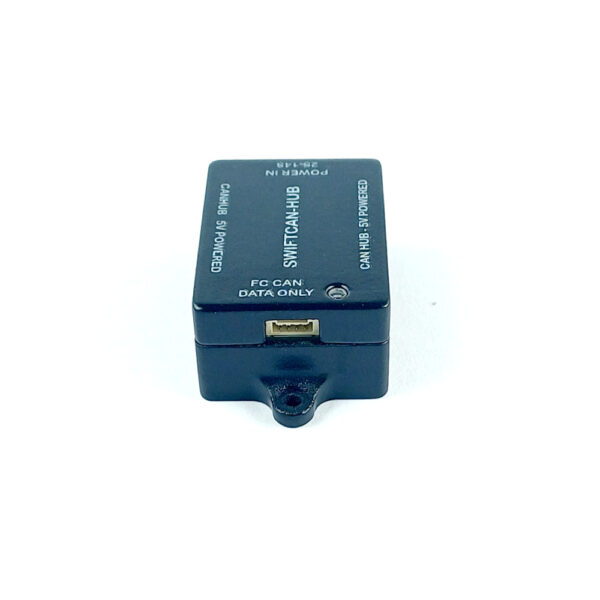
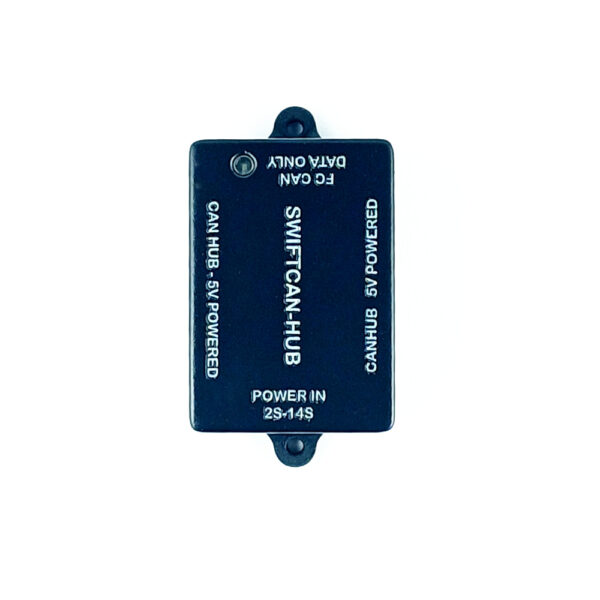
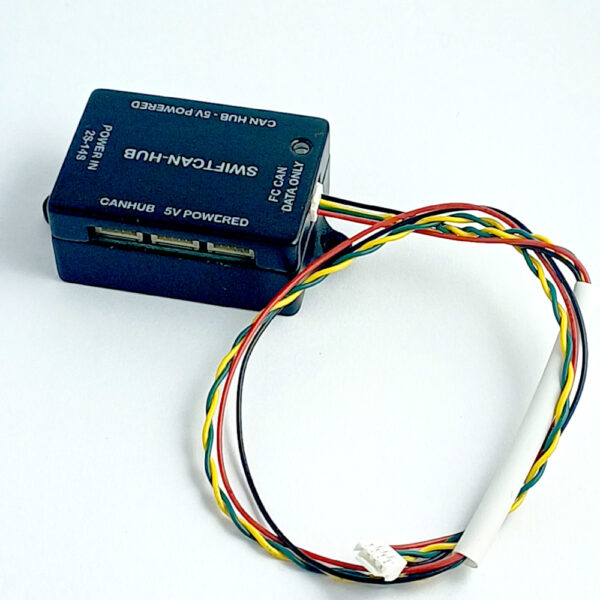
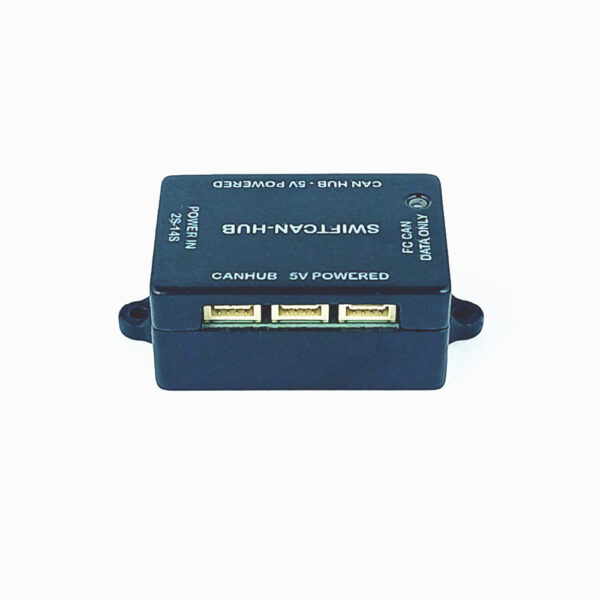
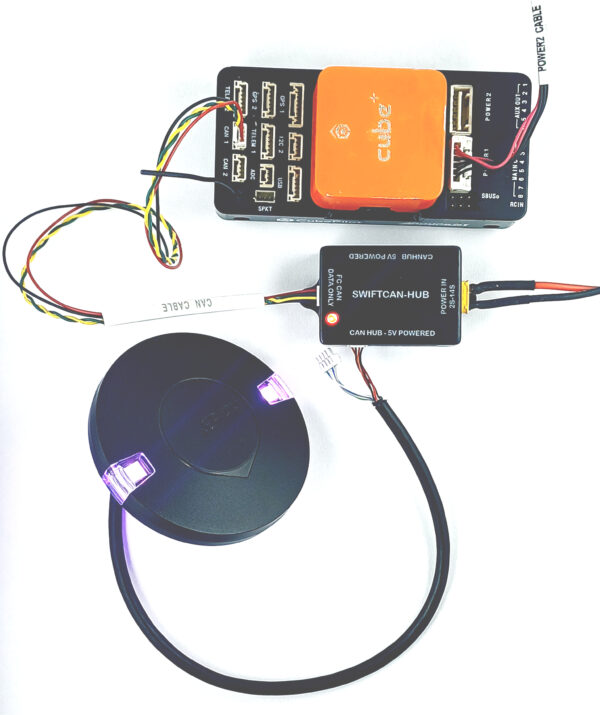
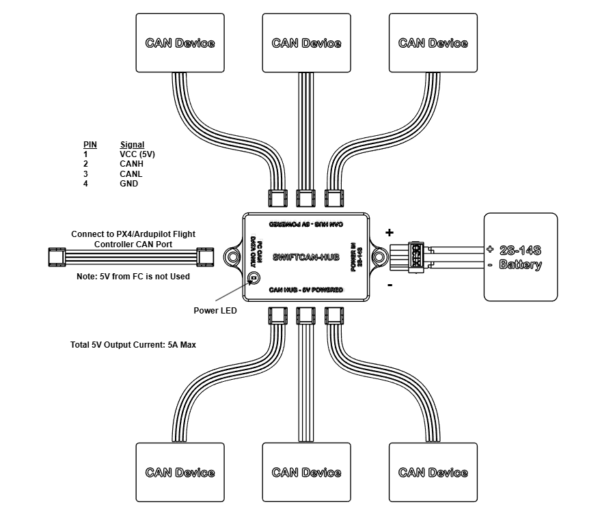
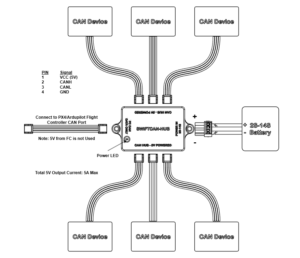
The SwiftCAN-HUB is a compact powered CAN hub designed for UAV, robotics, and autonomous vehicle applications. It expands a single flight controller CAN interface into six powered CAN ports, simplifying the integration of multiple CAN peripherals while providing a dedicated regulated power source.
Unlike passive CAN splitters that rely on flight controller power output, the SwiftCAN-HUB incorporates an onboard high-efficiency DC-DC regulator capable of delivering up to 5A total output current from a 2S–14S battery input.
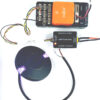
This allows connected CAN devices such as GPS modules, compasses, airspeed sensors, ESCs, power sensors, and rangefinders to be powered directly from the hub, reducing wiring complexity and avoiding overload of the flight controller CAN power rail.
Key Features
- Expands one CAN interface into six powered CAN ports
- Supports 2S–14S LiPo battery input
- Regulated 5.3V output for CAN peripherals
- Up to 5A total output current
- Dedicated Flight Controller CAN input
- JST-GH 4-pin connectors
- Integrated power status LED
- Compact enclosed design
- Ideal for UAV, VTOL, fixed-wing and robotics applications
- Easy installation using integrated mounting tabs
Why Choose SwiftCAN-HUB?
Many flight controllers provide limited current on their CAN ports, making it difficult to power multiple CAN peripherals reliably.
The SwiftCAN-HUB solves this problem by providing:
- Dedicated CAN peripheral power supply
- Stable 5.3V regulated output
- Reduced wiring complexity
- Clean CAN network expansion
- Support for multiple CAN devices on a single bus
Typical Applications
- DroneCAN GPS Modules
- CAN Magnetometers
- DroneCAN Airspeed Sensors
- CAN ESCs
- Power Sensors
- Rangefinders
- UAV Payload Controllers
- Robotics CAN Networks
Technical Specifications
| Parameter | Specification |
|---|---|
| Input Voltage | 2S–14S LiPo |
| Input Connector | XT30 |
| Output Voltage | 5.3V ±0.15V |
| Maximum Output Current | 5A Total |
| Efficiency | >90% |
| CAN Peripheral Ports | 6 |
| Flight Controller CAN Port | 1 |
| Peripheral Connector | JST-GH 4 Pin |
| Status Indicator | Red Power LED |
| Weight | 20g |
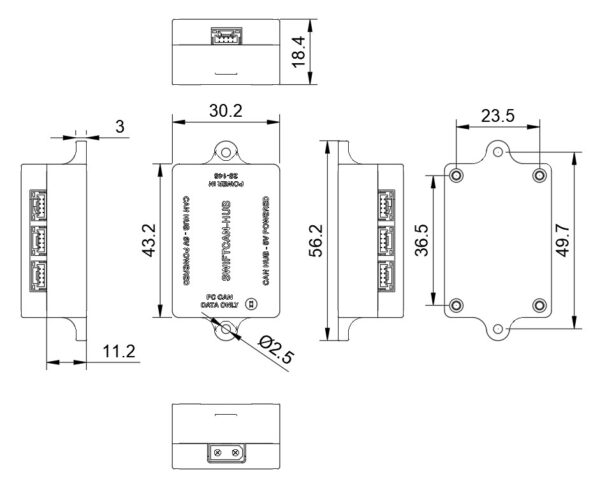
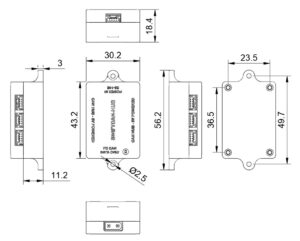
| Dimensions | 56.2 × 30.2 × 18.4 mm |
CAN Port Pinout
| Pin | Signal |
|---|---|
| 1 | VCC (5V) |
| 2 | CANH |
| 3 | CANL |
| 4 | GND |
Flight Controller CAN Port
The dedicated Flight Controller CAN port carries:
- CANH
- CANL
- GND
The flight controller 5V line is intentionally not connected.
All connected CAN peripherals receive power from the SwiftCAN-HUB’s internal 5.3V regulator.
Package Contents
- 1 × SwiftCAN-HUB
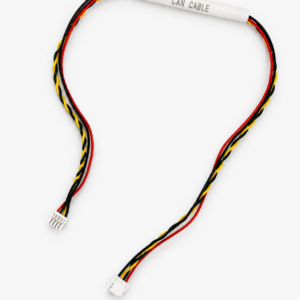
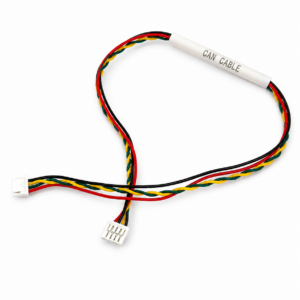
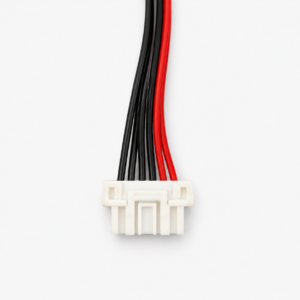
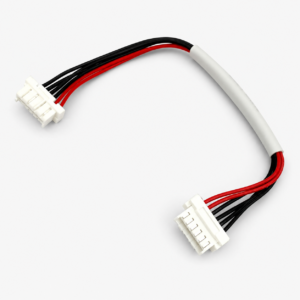
- 1 × JST-GH CAN Cable (30 cm)
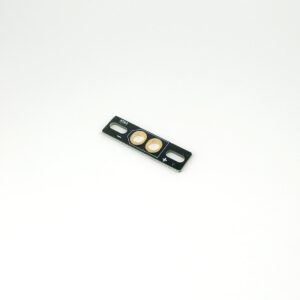
- 2 × M2.5 × 10 mm SS304 Socket Head Cap Screws
- 2 × M2.5 SS304 Nyloc Nuts
Compatibility
Compatible with:
- ArduPilot-based flight controllers
- PX4-based flight controllers
- DroneCAN peripherals
- CAN-based UAV sensors and devices
Important Note
The combined current consumption of all connected CAN peripherals must not exceed 5A total.
CAN bus termination should be provided by end devices as required by the system architecture.
Downloads
Refer Product Datasheet (PDF) for detailed information.
Frequently Asked Questions (FAQs)
1. What is the SwiftCAN-HUB used for?
The SwiftCAN-HUB expands a single CAN interface from your flight controller into six powered CAN ports, allowing multiple CAN peripherals to be connected while providing a dedicated regulated power supply.
2. Is this a passive CAN splitter?
No. Unlike passive CAN splitters, the SwiftCAN-HUB includes an onboard high-efficiency DC-DC regulator that powers connected CAN peripherals with a regulated 5.3V supply.
3. What input voltage does the SwiftCAN-HUB support?
The hub accepts a 2S–14S LiPo battery input through the XT30 connector.
4. How much current can the hub supply?
The onboard regulator can supply up to 5A total. The combined current consumption of all connected CAN peripherals must not exceed 5A.
5. Can the hub power my CAN peripherals?
Yes. All six peripheral CAN ports provide regulated 5.3V power from the hub’s internal power supply.
6. Does the Flight Controller CAN port provide 5V output?
No. The dedicated Flight Controller CAN port carries CANH, CANL and GND only. The 5V line is intentionally left unconnected to prevent back-powering the flight controller.
7. Can I use all six CAN ports at the same time?
Yes. All six CAN ports can be used simultaneously, provided the total current drawn by all connected peripherals remains within the 5A limit.
8. Is the hub compatible with DroneCAN devices?
Yes. The hub is fully compatible with DroneCAN peripherals and other CAN-based UAV devices. Since the hub simply distributes CAN communication and power, it does not depend on any specific CAN protocol.
9. Does the hub require any configuration?
No. The SwiftCAN-HUB is a plug-and-play hardware device. Device configuration, CAN node IDs, and communication settings are handled by the connected flight controller and CAN peripherals.
10. Does the hub terminate the CAN bus?
No. The SwiftCAN-HUB does not include CAN bus termination. CAN termination should be provided by the end devices as required by your CAN network.
11. Can I connect ESCs, GPS, compasses, airspeed sensors and power sensors together?
Yes. Multiple CAN peripherals can operate on the same CAN bus as long as each device has a unique CAN node ID and the total power consumption remains within the hub’s specifications.
12. What connectors are used?
The hub uses JST-GH 4-pin connectors for all CAN interfaces and an XT30 connector for battery power input.
13. Is mounting hardware included?
Yes. Mounting hardware is included for convenient installation.
14. Can the hub be used with custom CAN devices?
Yes. The SwiftCAN-HUB is protocol-independent and can be used with compatible CAN-based peripherals that follow the electrical characteristics of the CAN bus.
15. Is the enclosure included?
Yes. The SwiftCAN-HUB is supplied fully assembled in a protective enclosure and is ready for installation.
16. Can the SwiftCAN-HUB be used for I²C devices?
Yes. Since the board distributes four conductors, it can also be used as a passive I²C distribution board for compatible systems. However, unlike CAN, I²C is sensitive to cable length and total bus capacitance. Reliable operation depends on the overall system design and cable lengths.